


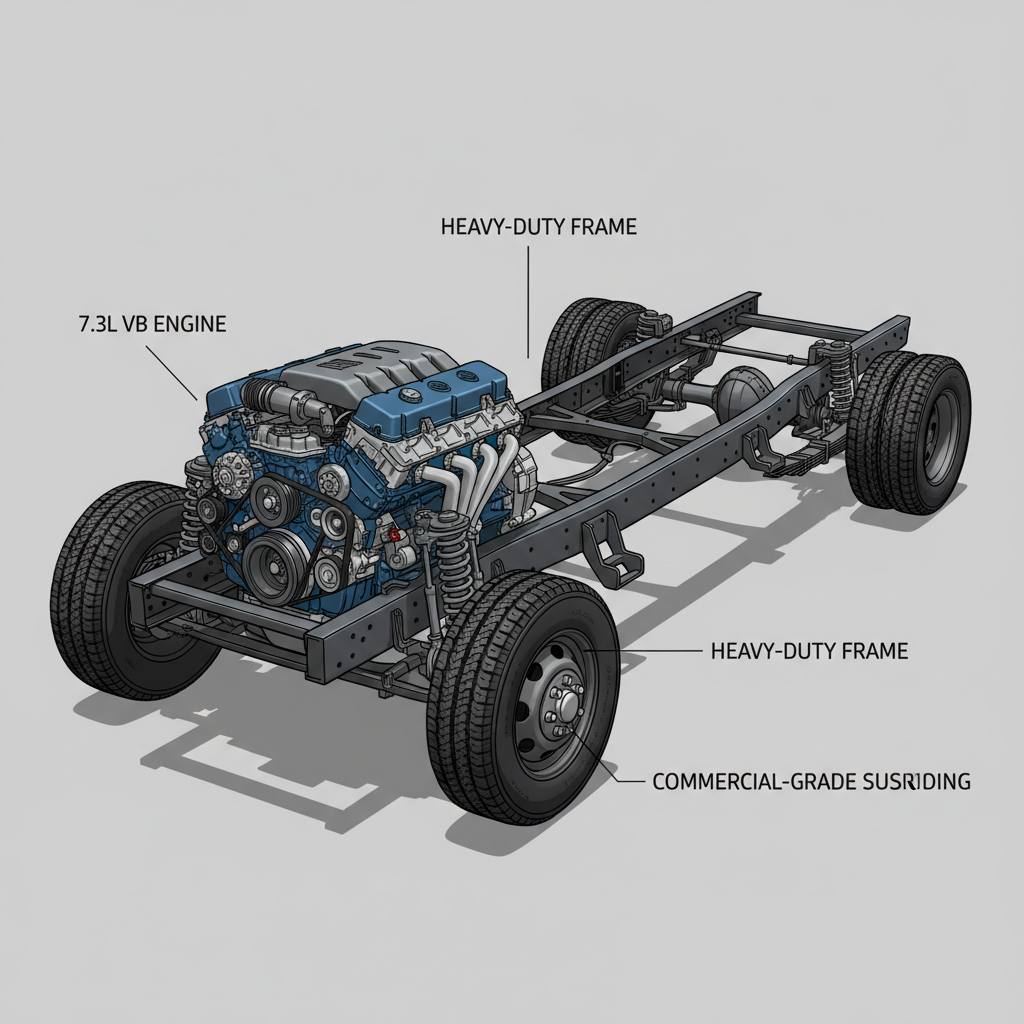
The Ford E Series is a highly durable range of commercial chassis cabs and stripped chassis manufactured by Ford Motor Company. Originally known as the Econoline, this robust platform provides a heavy-duty foundation for commercial applications, offering a powerful 7.3L V8 engine and immense payload capacities designed for demanding business operations.
- Ford E Series: The Ultimate Workhorse
- The Evolution of the Ford E Series Econoline
- First Generation (1961–1967)
- Second Generation (1968–1974)
- Third Generation (1975–1991)
- Fourth Generation (1992–Present)
- Analyzing the Modern Era: 2024 Ford E-Series and 2025 Ford E-Series
- Specialized Configurations: The 2025 Ford E-Series Box Truck and Cutaways
- Chassis, Powertrain, and Performance Specifications
- Safety Features, Technology, and Competitors
- Comparison Table of Key Specifications
- Driving the Future of Commercial Fleets
- Frequently Asked Questions (FAQs)
For decades, commercial fleets have relied on one specific vehicle platform to transport goods, serve as mobile workshops, and power emergency response teams. The Ford E Series represents the pinnacle of American commercial vehicle engineering. Businesses require reliable, easily modifiable vehicles to maintain operations, and this platform consistently delivers the necessary power and flexibility.
Whether you are managing a logistics company or researching a reliable chassis for a recreational vehicle, understanding the capabilities of the Ford E-Series will help you make an informed purchasing decision. This comprehensive guide breaks down the historical evolution, modern capabilities, specialized configurations, and what truly sets the Ford E-Series apart in today’s competitive commercial vehicle market.
Ford E Series: The Ultimate Workhorse
The Ford E Series remains the ultimate workhorse for the North American commercial market because it provides a highly customizable, heavy-duty framework capable of supporting immense weights. Ford Motor Company designed the modern iteration specifically as a cutaway chassis and stripped chassis, allowing aftermarket upfitters to attach customized rear bodies suited for distinct business needs.
Unlike lighter unibody vans, this rigid steel frame supports heavier loads without bending or warping over time, maximizing both durability and longevity. Fleet managers choose the Ford E Series van platform because its standardized cabin and chassis dimensions make it incredibly easy to transfer custom bodies from an older chassis to a newer one, significantly reducing long-term fleet costs. In addition, repair and replacement parts are easy to find across the United States, making maintenance cost-effective and minimizing downtime for businesses.
Fleet customers, including emergency services, delivery companies, and construction outfitters, have depended on the Ford E-Series as the backbone of their day-to-day operations, thanks to its uncompromising reliability and ruggedness. Due to its versatility, the Ford E Series chassis can be found in a remarkably wide spectrum of applications—from school buses and ambulances to armored vehicles and recreational motorhomes.
The Evolution of the Ford E Series Econoline
The history of the Ford E Series Econoline spans more than six decades. Initially introduced as a compact passenger and cargo van, it gradually evolved into the heavy-duty commercial powerhouse recognized today. Let’s take a closer look at each generation and see how the Ford E-Series adapted to meet the changing needs of businesses, individuals, and government organizations.
First Generation (1961–1967)
Ford introduced the first-generation Econoline in 1961 to compete with the Chevrolet Corvair 95 and the Volkswagen Transporter. Featuring a flat-nose, forward-control design, the engine was placed between the front seats. This configuration maximized interior cargo space while maintaining a highly compact exterior footprint. Available as a cargo or passenger van, and even a pickup version, the original Econoline stood out with its affordability and simplicity. It quickly found favor among small businesses and urban delivery routes where maneuverability and interior volume were essential.
Engine options during this era included modest inline-six engines—still adequate for urban deliveries and light-duty hauling. The unique control layout and compact turning radius made these first Econolines a hit in city settings, and later, they would become cult classics among vintage van enthusiasts.
Second Generation (1968–1974)
The second-generation Econoline shifted to a conventional front-engine layout. Ford moved the engine forward beneath a short hood, which drastically improved driver comfort, engine cooling, and front-end collision safety. This era saw the vehicle take on a bulkier and more substantial appearance, and the introduction of the powerful Windsor V8 engine option, setting the stage for its future as a heavy-duty commercial vehicle.
The improved frame and more robust powertrains offered users enhanced load-carrying ability, further broadening the van’s appeal. This generation was especially popular for conversion into camper vans and shuttle buses.
Today, enthusiasts still seek out the second-gen E Series vans for restoration and period builds, thanks to their simple mechanics and boxy, classic styling.
Third Generation (1975–1991)
Ford redesigned the platform entirely for the third-generation Econoline, utilizing a true body-on-frame construction—an innovation that would transform the E-Series into a foundation for heavy-duty commercial use. This solid construction meant that upfitters could build anything from ambulances and box trucks, to large RVs and mobile workshops on the Econoline platform.
With the introduction of diesel engine options and multiple V8 gasoline engines, the third-generation E-Series offered commercial users superior low-end torque and enhanced fuel economy for highway use. By now, Ford had expanded configuration options, including different wheelbases, multiple roof heights, and trim packages, from work-ready base models to fully-appointed Club Wagons. During this period, the Econoline became a mainstay for police prisoner transport, government fleets, airport shuttles, and even church groups.
The abundance of available used models from this era explains why so many remain on the road today, decades after their debut.
Fourth Generation (1992–Present)
The fourth-generation Ford E Series introduced significant aerodynamic improvements, upgraded interior ergonomics, and advanced safety features. Ford took customer feedback seriously—improving visibility, adding padded dashboards, airbags, and anti-lock brakes, and reducing road noise within the cabin.
While Ford discontinued the traditional enclosed passenger and cargo van versions in 2014—replacing them with the innovative Ford Transit—the company retained the cutaway chassis and stripped chassis models due to overwhelming demand from commercial upfitters and specialty equipment installers. Since then, the E-Series has solidified its reputation for adaptability, powering ambulance fleets, school transportation, food trucks, and so much more.
Over the years, technologies such as electronic stability control, factory telematics, and advanced connectivity have kept the E-Series relevant, up-to-date, and compliant with ever-tightening safety regulations.
Analyzing the Modern Era: 2024 Ford E-Series and 2025 Ford E-Series
The modern era of the Ford E Series strictly focuses on heavy-duty commercial applications. The 2024 ford e-series and the incoming 2025 ford e-series utilize a modernized dashboard, an updated instrument cluster, and a revised steering column to improve driver comfort and intuitiveness—meeting the demands of drivers who spend long hours on the road.
The 2024 ford e-series provides businesses with standard fleet telematics through the Ford Pro Telematics software system. Fleet managers and owners get real-time data on vehicle diagnostics, driver habits, fuel consumption, and live GPS locations, making it easier to schedule preventive maintenance and optimize routes. This digital connectivity improves both efficiency and safety on the job.
The 2025 ford e-series continues this trend, offering enhanced alternator output options to power demanding aftermarket equipment, such as heavy-duty hydraulic lifts, refrigeration units, or onboard medical machinery. Ford has also expanded their upfitter interface module, facilitating seamless integration with third-party add-ons—critical for conversions ranging from mobile offices to food trucks.
Modern steering columns and dashboard layouts have become more driver-focused. Innovations like optional tilt/telescoping steering, integrated Bluetooth for hands-free communication, and available back-up cameras help business owners meet occupational safety requirements and insurance standards.
With every update, the E-Series maintains its position as a backbone of American commerce and industry, engineered to withstand rough use and relentless mileage.
Specialized Configurations: The 2025 Ford E-Series Box Truck and Cutaways
Commercial buyers customize the Ford E Series cutaway chassis to fit exact business requirements. The standard cabin features two front seats and an open rear section, ready to accept an enormous range of attachments.
The 2025 ford e-series box truck configuration is incredibly popular among moving companies, parcel delivery services, construction providers, and furniture distributors. Upfitters attach large, enclosed aluminum or fiberglass boxes to the chassis rails, offering maximum dry storage and weather protection. These box trucks can be optioned with roll-up rear doors, interior shelving, walk ramps, and even liftgates, making them indispensable for last-mile logistics and field service work.
Additionally, the E-Series platform forms the flesh and bones of shuttle buses, ambulances, paratransit vans, and motorhomes. The stripped chassis variant, which ships with no cab, is often used as the base for walk-in delivery vans (like bread trucks) and luxury Class A recreational vehicles.
- Ford E Series Van: Earlier models were enclosed cargo or passenger vans—still popular as used vehicles for tradesmen, shuttle services, and small businesses.
- Ford E-Series: Today refers mainly to the cutaway and stripped chassis models used by upfitters and specialty builders.
- Ford E-Series Econoline: The classic badge associated with heritage models, especially in restoration and enthusiast circles.
- 2025 Ford E-Series Box Truck: A modern and robust solution for large cargo businesses and hire fleets.
Thanks to this modular design, the E-Series continuously wins over buyers looking for a platform flexible enough to handle custom builds, unique storage, or system integration needs that no one-size-fits-all van could match.
Chassis, Powertrain, and Performance Specifications
Performance and durability define the mechanical components of the Ford E Series. The E-Series is designed to haul and tow the heavy loads its users demand, and its robust engineering reflects this commitment.
The sole powertrain option for the current generation is a massive 7.3L naturally aspirated V8 gas engine. This engine produces 325 horsepower and 450 lb-ft of torque, delivering the low-end pulling power required for heavy commercial loads, steep grades, and stop-start city driving. Ford pairs this engine with a highly durable TorqShift 6-speed automatic transmission, which includes a specialized Tow/Haul mode that adjusts shift points and reduces gear hunting to handle steep grades and heavy cargo safely.
The Gross Vehicle Weight Rating (GVWR) of the Ford E-Series ranges from 10,050 lbs (base E-350) to a staggering 14,500 lbs (top-spec E-450), providing the flexibility to tackle any job. The heavy-duty suspension utilizes twin-I-beam front axles and leaf spring rear suspensions, ensuring the vehicle remains stable even when loaded to maximum capacity or exposed to rough worksite terrain.
Fuel options for upfitters also extend beyond regular gasoline—propane and CNG conversions are available on certain models, helping businesses reduce emissions or meet specific contract requirements.
Ford E Series Towing and Payload Stats (Highlights):
- Maximum Payload (E-450): Nearly 9,000 lbs (with box truck van body removed)
- Maximum Conventional Towing: Up to 10,000 lbs, depending on configuration
- Fuel Tank(s): Between 40 and 55 gallons, depending on wheelbase
These capabilities define why the E-Series continues to be the gold standard in special-use vehicles in North America.
Safety Features, Technology, and Competitors
Safety in modern commercial vehicles protects both the driver and the company’s liability. For the E-Series, contemporary safety goes beyond seat belts and airbags:
- Electronic Stability Control (ESC): Reduces the risk of rollover in sudden maneuvers or poor grip conditions.
- Traction Control: Helps maintain tire grip during inclement weather or on slippery work sites.
- Hill Start Assist: Gives drivers control on steep ramps with a fully loaded vehicle.
- Advanced Driver Assistance Systems (ADAS): Options like adaptive cruise control, forward collision warning, and lane departure warning can be added to meet or exceed corporate safety requirements.
- Factory-Installed Safety Equipment: Features include rearview cameras, additional side mirrors, and upfitter modules supporting emergency lighting or external monitoring equipment.
The interior has also evolved: new digital instrument displays, improved ergonomics, optional hands-free communications, and available telematics keep both operators and fleet managers informed and aware.
Major Competitors
The primary competitor to the Ford E-Series is the Chevrolet Express Cutaway (and, occasionally, the GMC Savana Cutaway). While the Chevy Express offers reliability, the Ford E Series consistently leads the market segment due to its superior payload capacities, user-friendly frame design, and the immense torque output of the 7.3L V8 engine. Other rivals, like the Ram ProMaster and Mercedes-Benz Sprinter, have made inroads in the van space but rarely match the E-Series’ popularity with upfitters especially for cutaway and chassis applications.
Comparison Table of Key Specifications
| Specification Feature | Ford E-350 Cutaway | Ford E-450 Cutaway |
| Engine | 7.3L Premium-Capable V8 | 7.3L Premium-Capable V8 |
| Horsepower | 325 hp @ 3,750 rpm | 325 hp @ 3,750 rpm |
| Torque | 450 lb-ft @ 3,250 rpm | 450 lb-ft @ 3,250 rpm |
| Transmission | 6-speed TorqShift Auto | 6-speed TorqShift Auto |
| Max GVWR | 10,050 – 12,500 lbs | 14,000 – 14,500 lbs |
| Wheelbase Options | 138″, 158″, 176″ | 158″, 176″ |
| Fuel Capacity | 40-55 gal (varies) | 40-55 gal (varies) |
| Max Tow Rating | Up to 10,000 lbs | Up to 10,000 lbs |
| Max Payload | Up to ~7,210 lbs | Up to ~8,980 lbs |
| Alternative Fuels | Gasoline, LPG, CNG | Gasoline, LPG, CNG |
Driving the Future of Commercial Fleets
The Ford E-Series has proven its resilience and adaptability over six decades of continuous service. By transitioning exclusively to a cutaway and stripped chassis platform, Ford ensured this vehicle remains relevant for the heaviest commercial tasks. The E-Series chassis is the foundation upon which mobile medical vehicles, luxury class C motorhomes, airport shuttles, utility service trucks, and food trucks are built.
For any organization requiring a platform capable of severe-duty towing, massive payload capacities, and infinite customizability, the Ford E Series remains the industry-standard choice. Fleet managers should evaluate specific payload requirements, required body modifications, and long-term maintenance when deciding between the E-350 and E-450 chassis models, ensuring maximum efficiency and return on investment for their business operations.
The unwavering demand for the ford e-series chassis by specialists and upfitters highlights the advantage of Ford’s robust commercial support network. Dealers and repair shops across the U.S. ensure that critical parts and technical support are available at every turn.
Contact and Support
To learn more about the latest configurations, upfitter options, and pricing, visit the Ford Commercial Vehicles website or reach out directly to your local Ford Pro dealer. For existing fleet managers, connecting with your Ford Fleet representative can streamline the upfitting and acquisition process.
Frequently Asked Questions (FAQs)
Did Ford stop making the E Series?
No, Ford did not stop making the Ford E Series. While the enclosed passenger and cargo van variants were discontinued in 2014 to make way for the Ford Transit, Ford continues to manufacture the cutaway chassis and stripped chassis configurations for commercial upfitting. The E-Series remains a cornerstone of the Ford fleet lineup in 2024 and upcoming 2025 model years.
What is the difference between a Ford E-350 and E-450?
The main difference is their weight capacity. The Ford E-450 features a heavier-duty frame, upgraded suspension, and a higher Gross Vehicle Weight Rating (GVWR) of up to 14,500 lbs. The Ford E-350 has a maximum GVWR of 12,500 lbs, making it suitable for slightly lighter applications. Depending on the application, either model can be upfitted with various bodies, but the E-450 is best suited for heavy-duty responsibilities and the largest cutaway builds.
What engine is in the 2024 Ford E-Series?
The 2024 ford e-series comes equipped with a 7.3L naturally aspirated V8 gasoline engine. This heavy-duty engine, codenamed “Godzilla,” delivers 325 horsepower and 450 lb-ft of torque, specifically engineered for high-durability commercial use and capable of running on alternative fuels such as liquid propane or compressed natural gas.
How much can a 2025 Ford E-Series box truck carry?
The payload capacity of a 2025 ford e-series box truck depends on the chassis model and the weight of the attached box. An E-450 chassis has a maximum payload rating of nearly 9,000 lbs, but the usable payload for cargo will be this number minus the weight of the aftermarket box and any interior shelving or equipment.
Is the Ford E Series good for an RV conversion?
Yes, the Ford E Series is an industry standard for Class C motorhome conversions. Its rigid steel frame, powerful V8 engine, and high GVWR provide the necessary stability and towing capacity required to carry heavy RV living quarters and tow a secondary vehicle safely. Most major RV brands build their midsize and luxury campers on the E-Series chassis to this day.