


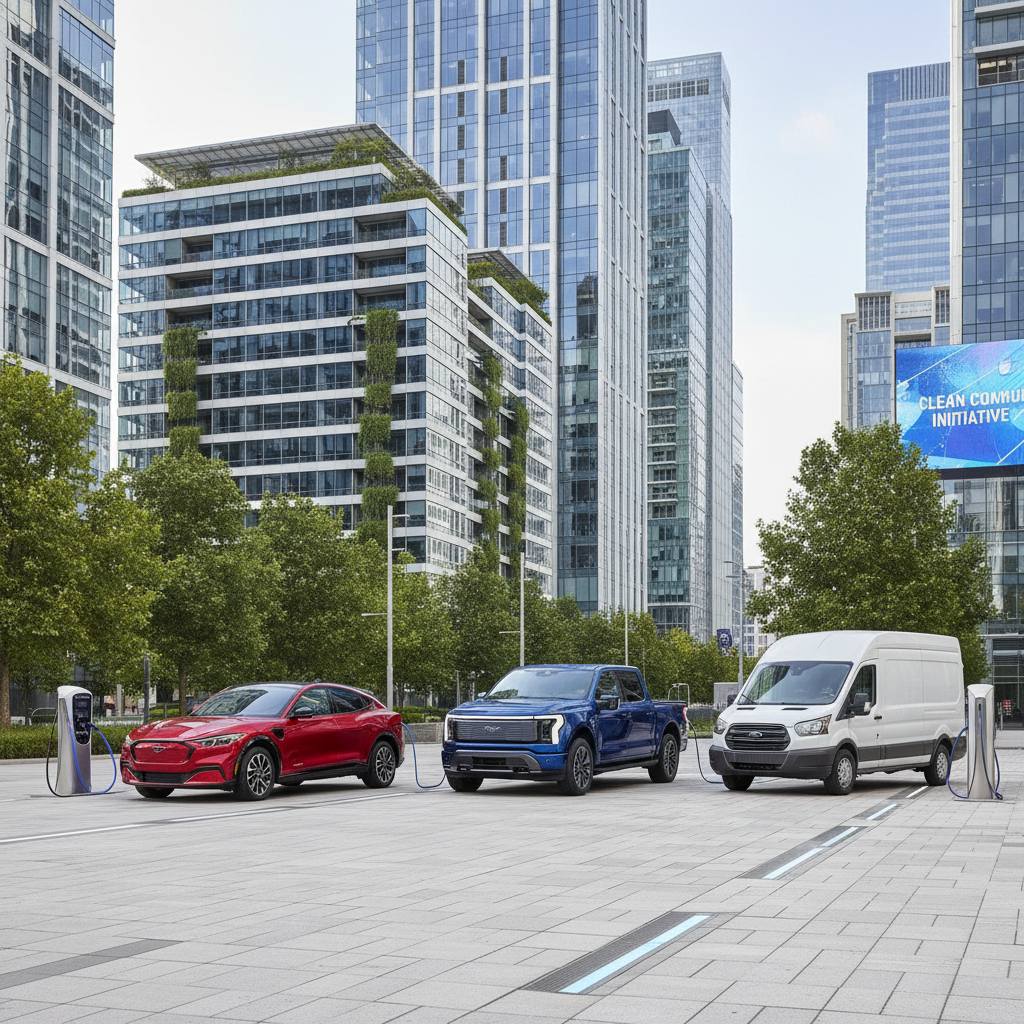
Making the jump to zero-emissions driving is a big decision. You need a vehicle that fits your lifestyle, offers reliable battery range, and delivers the performance you expect. The Ford Motor Company has stepped up to the plate, creating a dynamic lineup of battery electric vehicles (BEVs) that blend iconic design with cutting-edge technology.
- What Are Ford Electric Cars?
- Meet the Ford EV Lineup
- Mustang Mach-E: The Thrilling Electric SUV
- F-150 Lightning: The Ultimate Electric Truck
- E-Transit: The Reliable Commercial Van
- Comparison Table: Ford Electric Cars
- Charging Your Ford Electric Cars: Home and Public Options
- Performance, Battery Range, and Kilowatt-Hour Capacity
- Affordability: Tax Credits, Rebates, and Savings
- Maintenance and Safety Features for Zero-Emissions Driving
- Ford Electric Cars and the Competition
- Ownership Experience, Support & Going Electric with Ford
- 5 Most Searched FAQs About Ford Electric Cars
In this comprehensive guide, we break down the entire lineup of Ford Electric Cars for you. You’ll discover details about each model, learn how to manage home charging and public charging, understand what kind of kilowatt-hour capacity you can expect, and get all the latest information on tax credits and rebates that can make the switch to electric more affordable. As the demand for electric vehicles grows, it’s important to know how Ford Electric Cars stack up against the competition and what makes them stand out on American roads.
What Are Ford Electric Cars?
When we talk about Ford Electric Cars, we are looking at a specific group of vehicles completely powered by a lithium-ion battery and electric motors. Unlike hybrid models that still use a gas engine, these are 100% zero-emissions vehicles, meaning they produce no tailpipe pollution and help reduce your carbon footprint.
Over the last few years, Ford has focused on electrifying its most legendary nameplates, staying true to what drivers love while pushing the boundary of future mobility. Instead of building only quirky, niche EVs, they took their most popular and proven vehicles—like the classic Mustang and the best-selling F-150—and transformed them into powerful electric vehicles. This approach, seen in the creation of the Mustang Mach-E and the F-150 Lightning, ensures that drivers do not have to compromise on utility, towing capacity, or driving thrill when they switch to electric power.
Whether you need a daily commuter, a family electric SUV, or a rugged electric pickup truck, Ford Electric Cars offer a practical and exciting solution for modern drivers. This variety places Ford at the center of the evolving automotive landscape, where electrification is no longer a trend but a necessity for sustainability and future prosperity.
The Evolution of the Blue Oval’s EVs
The journey of Ford Electric Cars began with a deep commitment to sustainability and innovation. It’s a history built on decades of engineering prowess and a willingness to lead the automotive industry toward a greener future. Ford invested heavily in battery technology—including developments in lithium-ion chemistry—for increased range and durability, and electric drivetrains that can handle both spirited driving and hard work. Today, Ford stands as a leading force in the EV market, offering vehicles that boast incredible torque, massive cargo space (including the innovative frunk, or front trunk), and advanced software like the Ford BlueCruise hands-free driving system.
A defining chapter in Ford’s electric story was the introduction of the Mustang Mach-E, a bold electric SUV that became one of the brand’s bestsellers and an award winner worldwide. The F-150 Lightning, another significant milestone, redefines what an electric pickup truck can achieve. Both models signal Ford’s dedication to building vehicles that meet the real-world needs of buyers—from adventure seekers to small business owners. The E-Transit further showcases Ford’s commitment by helping commercial operators lower their operating costs while helping cities across America and beyond meet clean transportation goals.
Meet the Ford EV Lineup
The current lineup of Ford Electric Cars features three main pillars, each serving a distinct driver demographic. From exciting performance to hard-working practicality, every vehicle is engineered for the real world. Let’s look at each in depth, so you can decide which Ford EV is right for your needs.
Mustang Mach-E: The Thrilling Electric SUV
The Mustang Mach-E takes the soul of the legendary pony car and injects it into a versatile electric crossover. Designed for families, tech lovers, and performance enthusiasts alike, it delivers adrenaline-pumping acceleration, with some trims (like the GT Performance Edition) launching from 0 to 60 mph in under 3.5 seconds. Drivers can choose between rear-wheel drive and eAWD (all-wheel drive), along with standard or extended-range battery options for added flexibility.
The Mach-E’s estimated electric range of up to 300+ miles on a single charge can alleviate most range anxiety issues. Its spacious, tech-forward interior is centered around a 15.5-inch touchscreen—home to Ford’s latest SYNC infotainment system. Materials are thoughtfully chosen for quality, and cargo capacity rivals even some midsize SUVs, letting you pack everything you need for a weekend trip.
In addition to performance numbers, the Mustang Mach-E is packed with safety and convenience features such as Lane-Centering, Adaptive Cruise Control, and the available BlueCruise hands-free system. You can also customize the car’s drive feel with unique modes like Whisper (for quiet relaxation), Engage (for everyday balance), or Unbridle (for the full Mustang experience).
F-150 Lightning: The Ultimate Electric Truck
If you need to haul, tow, and work hard, the F-150 Lightning is the answer. As the electric version of America’s favorite truck, it offers massive horsepower and instant torque—delivering up to 580 horsepower and 775 lb-ft of torque on certain trims. The F-150 Lightning retains the iconic toughness of the standard F-150 but adds unique EV benefits: the Mega Power Frunk offers secure storage and doubles as an ice chest, while Pro Power Onboard transforms the truck into a mobile generator for job sites or camping.
Towing capacity is up to 10,000 pounds, and with an available range of up to 320 miles, this truck works as hard as you do. The F-150 Lightning also features advanced tech like over-the-air updates, a huge 15.5-inch portrait touchscreen, and support for features like phone-as-a-key. For safety and flexibility, buyers can equip multiple camera angles, driver-assist tech, and rugged off-road options. All of this comes with reduced running costs, and the confidence of Ford’s deep knowledge in truck durability.
E-Transit: The Reliable Commercial Van
For business owners, the E-Transit offers a zero-emissions solution for deliveries, logistics, and trades. Available in multiple roof heights and lengths, the E-Transit cargo van provides a cavernous payload capacity of around 3,800 pounds without the operating costs of a gas-powered van. It’s ideal for companies seeking to modernize their fleets and comply with emerging emissions standards nationwide.
With an estimated range of up to 159 miles—enough for many day-long commercial routes—and features such as Ford Pro’s telematics suite, every aspect of fleet management is simplified. Drivers enjoy a powerful motor for smooth acceleration even when fully loaded, and the simple design means less time in the shop and more on the road. If you’re a small business owner or fleet manager, E-Transit is engineered to lower your total cost of ownership—and it aligns with the eco-conscious values of today’s customers.
Comparison Table: Ford Electric Cars
To help you decide which vehicle fits your budget and driving needs, here is a quick comparison of the core Ford Electric Cars available right now.
| Model | Starting Price (MSRP) | Estimated Range | Vehicle Type | Power/Torque | Cargo/Frunk Space |
| Mustang Mach-E | $39,840 | 250 – 320 Miles | Electric SUV | Up to 480 HP/634 lb-ft | 29.7 cu ft + front trunk |
| F-150 Lightning | $51,975 | 240 – 320 Miles | Electric Truck | Up to 580 HP/775 lb-ft | 14.1 cu ft frunk |
| E-Transit 350 | $55,355 | 148 – 159 Miles | Commercial Van | 266 HP/317 lb-ft | Up to 487.3 cu ft cargo |
Note: Pricing, range, and performance figures vary based on battery size, trim level, and optional equipment. Always check current Ford resources or with your local dealer for full specs.
Charging Your Ford Electric Cars: Home and Public Options
One of the biggest concerns for new EV owners is charging. Thankfully, powering up Ford Electric Cars is highly convenient, whether you are parked in your garage, at work, or on a cross-country road trip.
Home Charging Solutions
Most charging happens at home. When you buy from the lineup of Ford Electric Cars, you can install the Ford Charge Station Pro or a standard Level 2 home charger. Plugging into a 240V outlet overnight easily replenishes your kilowatt-hour capacity, ensuring you wake up with a full battery every morning. The Level 2 charger can typically add up to 30 miles of range per hour of charging. For many, this means a complete charge in under 10 hours.
Ford also offers the Ford Power Promise, providing comprehensive support to make your transition to an electric lifestyle seamless. Services include help with charger installation, warranty plans for wall units, and virtual help desks to answer charging questions. With the convenience of home charging, waking up every morning to a full “tank” becomes the new norm for Ford EV owners.
The BlueOval Charge Network and Tesla Superchargers
When you are on the road, the BlueOval Charge Network is your best friend. It is the largest public charging network in North America, aggregating multiple charging providers—such as Electrify America, EVgo, Greenlots, and more—into one easy-to-use system, all accessed via the FordPass App.
Recently, Ford made a massive leap forward by securing access to Tesla Superchargers for their drivers. Using a NACS adapter (North American Charging Standard), owners of Ford Electric Cars can now plug into thousands of high-speed Tesla stations across the country, gaining access to over 15,000 Superchargers. This integration drastically reduces range anxiety and makes long-distance travel not just possible, but convenient. All Ford EVs will soon feature NACS ports for direct access, so compatibility is futureproof.
Public charging can be rapid—most DC fast chargers add 100+ miles of range in under 20 minutes—making it easy to stop for a coffee or a quick lunch and continue your journey with confidence. Ford is continuously working to expand fast-charging locations to support increasing demand, keeping America’s highways open to electric explorers and commuters alike.
Performance, Battery Range, and Kilowatt-Hour Capacity
You might wonder if Ford Electric Cars can keep up with their gas-powered siblings. The answer is a resounding yes. Because electric motors deliver 100% of their torque instantly, these vehicles offer eye-opening performance and a new driving sensation.
Depending on the model, you will find different battery packs measured in kilowatt-hours (kWh). For instance:
- The Mustang Mach-E comes with either a standard 70 kWh or extended-range 91 kWh battery, offering output from 266 to 480 horsepower.
- The F-150 Lightning features a standard 98 kWh battery or up to 131 kWh in the extended-range version, delivering robust acceleration, a quiet ride, and serious towing muscle.
- The E-Transit uses a 68 kWh battery that’s designed around the real-world routes of delivery businesses and urban operators.
These systems are paired with advanced thermal management, keeping battery cells at an optimal temperature for longevity and reliability—even in harsh climates from northern winters to southern heat waves. Ford constantly updates battery management firmware over the air, optimizing range and efficiency as technology progresses.
Charging ports are conveniently located, and all Ford EVs use a universal connector, with adapters available for the growing Tesla Supercharger network. Regenerative braking captures energy during deceleration, further boosting range and reducing brake wear.
Towing and hauling are fully within the capabilities of these vehicles: the F-150 Lightning can tow up to 10,000 pounds, while the Mach-E comfortably handles bikes, sports equipment, and weekend gear. The flat battery platform in these vehicles provides a low center of gravity, improving stability in corners and safety in sudden maneuvers.
Affordability: Tax Credits, Rebates, and Savings
While the upfront cost of Ford Electric Cars can sometimes be higher than gas vehicles, the long-term savings are substantial. Let’s break down where you’ll save money—and how you can make the most of incentives.
- Federal Tax Credits: Many Ford EV models qualify for federal incentives of up to $7,500, depending on battery composition and cost caps. These credits can significantly lower your effective purchase price.
- State and Local Rebates: Several states (such as California, Colorado, and New York) offer their own rebates, which can be up to $2,000 or more. Search your state’s official government site for the latest programs, eligibility, and application steps.
- Dealer Incentives: Ford dealerships often run limited-time offers or partner with utility companies, so be sure to ask about current promotions when you shop.
- Fuel Savings: By going electric, you avoid the unpredictable cost of gasoline. On average, electricity costs are 50-80% less than gas per mile, resulting in sizable annual savings.
- Maintenance Savings: Electric vehicles have fewer moving parts than gas vehicles, meaning less can go wrong. Expect savings on oil changes, exhaust work, cooling system repairs, and more.
Your total cost of ownership should be calculated based on all these points, plus residual value. Ford’s strong reputation for durability helps maintain high resale values for its EV lineup.
Maintenance and Safety Features for Zero-Emissions Driving
Maintaining Ford Electric Cars is much simpler than for internal combustion vehicles. Instead of oil changes, spark plug replacements, and costly transmission flushes, maintenance is often limited to tire rotations, brake checks (thanks to regenerative braking extending pad life), and periodic coolant top-ups for the battery and electronics systems.
Ford covers all high-voltage battery components with an 8-year/100,000-mile warranty, so you can drive confidently knowing service support is in place. This peace of mind reassures both first-time buyers and fleet managers when considering an EV purchase.
Safety technology is equally robust. All Ford Electric Cars are equipped with driver-assist features including:
- Pre-Collision Assist with Automatic Emergency Braking: Detects vehicles and pedestrians to help prevent accidents before they happen.
- Blind Spot Information System (BLIS): Monitors your blind zones and alerts you of approaching vehicles.
- Lane-Keeping System: Gently corrects your steering if you unintentionally drift.
- Adaptive Cruise Control: Keeps your EV at a safe following distance, even in stop-and-go traffic.
- 360-degree Cameras: Ease parking and maneuvering in tight spots.
- Ford BlueCruise: Available on select models, enabling hands-free driving on mapped interstates and highways.
Ford’s platform scores top marks in crash tests and incorporates advanced crumple zones and high-strength steel for enhanced occupant protection.
Ford Electric Cars and the Competition
It’s important to consider competitors in the electric vehicle market. Ford faces competition from companies like Tesla, Chevrolet (Bolt EV), Volkswagen (ID.4), Hyundai (IONIQ 5), and Rivian (R1T). However, Ford Electric Cars combine a legacy of reliability, impressive performance, excellent dealer support, and a growing network of charging infrastructure—giving them a real-world advantage for many buyers, especially those new to EVs.
Ownership Experience, Support & Going Electric with Ford
With Ford Electric Cars, support doesn’t end when you leave the dealership lot. Owners receive access to Ford’s extensive dealer network. From quick online scheduling for service, to knowledgeable EV specialists, you’re never alone in the transition to electric driving.
FordPass links drivers to remote diagnostics, maintenance reminders, and preconditioning features (like warming the cabin on cold mornings while still plugged in). If you need help on the road, Ford’s Roadside Assistance provides assistance for flat tires, low battery, or towing to the nearest public charging station.
Ford also engages in regular software and system updates, adding features and improving vehicle performance via over-the-air technology—which means your vehicle gets better over time!
For business, Ford Pro delivers commercial solutions with fleet telematics, real-time diagnostics, and cost management tools, ensuring that the ownership experience is efficient and supportive from day one.
5 Most Searched FAQs About Ford Electric Cars
- What is the cheapest of the Ford Electric Cars?
The most affordable model in the current lineup of Ford Electric Cars is the Mustang Mach-E. Its starting price generally hovers around $39,840 for the base Select trim, making it a highly competitive option in the electric SUV market. - Can I charge my Ford EV at a Tesla Supercharger?
Yes. Owners of Ford Electric Cars can use a NACS adapter to access thousands of Tesla Superchargers across North America. This massively expands the available public charging infrastructure for Ford drivers, opening up new long-distance travel options. - Do Ford Electric Cars qualify for federal tax credits?
Many models and trims within the Ford EV lineup do qualify for federal tax credits. However, eligibility depends on the specific battery configuration, the vehicle’s MSRP, and the buyer’s income level. Always verify current federal guidelines before purchasing to ensure maximum savings. - How long does the battery last in a Ford Electric Car?
The lithium-ion battery packs in Ford Electric Cars are designed to last the lifetime of the vehicle. Ford backs its high-voltage battery components with an 8-year/100,000-mile warranty, ensuring long-term reliability and performance. Real-world data shows minimal degradation over the first several years of use. - What happens if my Ford EV runs out of charge on the road?
If you deplete your kilowatt-hour reserves, the FordPass App and Ford’s Roadside Assistance have your back. They will help arrange a tow to the nearest public charging station or dealership within the BlueOval Charge Network so you can plug in and get back on the road safely. Plus, the Ford app helps monitor your charge status and plan routes with charging stops included.
Final Thoughts: Is a Ford Electric Car Right for You?
As mainstream adoption of EVs accelerates, Ford Electric Cars remain a top choice for drivers seeking a blend of performance, practicality, and innovative features. Every vehicle is built with Ford’s legendary reliability and supported by a growing infrastructure designed to make electric driving simple. Whether you’re a family in need of space, a small business looking for operating cost reductions, or a truck owner wanting to embrace clean power without giving up capability, Ford has the electric car for your needs.
When you’re ready to take the next step, visit a local Ford dealership for a test drive or browse the latest offers online. From rebates to robust customer support, Ford’s commitment to the electric future is clear—and you can be a part of it today.